| 1907 From 1907
through 1909, "Union" of White County, TN appears simultaneously in
the records of both Presbyterian denominations--the
Cumberland Presbyterian Church (CPC) and the Presbyterian
Church in the United States of America (PC-USA). This would
seem to indicate that:
- The church, although split in sentiments and
denominational loyalties, was still meeting as one congregation
but the leadership of each faction was sending reports (possibly
for the whole group) to the denominational headquarters of their
preference, or...
- The church was split into two factions and
these were meeting separately, both of whom were claiming the
"Union" name for their congregations.
Cumberland Presbyterian Congregation in Exile?
| There is no entry in the Union Church
minutes from April
19, 1907 to July 11, 1909. It is very possible that
the Cumberland Presbyterian loyalists of the Union Church were
exiled from the church house for a couple of years or so
during this time and that the building was controlled by
Presbyterian Church of the U.S.A. "unionists" until April
1910, 1909. Whether they met for worship in another
location (perhaps the River Hill school house, about
1/2 mile from the Union Church) or ceased to assemble during
this time...we do not know. |
|
Union
Church,
Cumberland Presbyterian
|
Union
Church,
Presbyterian U.S.A.
|
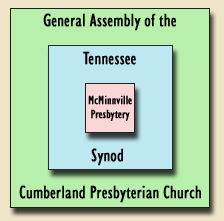
McMinnville Presbytery
CPC Session
at the Hebron/Irving College
Church
in Warren County |
McMinnville Presbytery
U.S.A.
Spring 1907 Session |
|
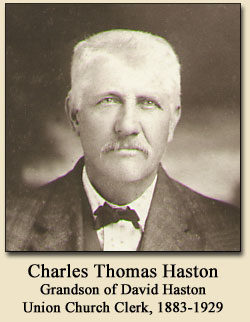
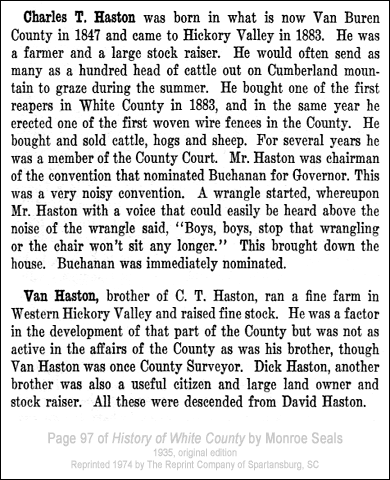
April 19-21, 1907 -- C.T.
Haston represented the Union Church. C.T. Haston was
listed as the Session Clerk of Union and his mailing address
was Sparta, TN.
Note: In the
March 3, 1907 business
session of the Union Church, C.T. Haston had been elected to
represent the church at this meeting.
At that time, the roll of ministers consisted only
of four ministers: C.K. Carlock, A.C. Tatom, W.E. Tillett, and J.L.
Thompson. The ministerial pool for this presbytery,
apparently, had been decimated by the 1906 denominational split.
When the meeting began, eleven churches were represented and ten
were listed as "not represented," including these White County
churches: Blue Springs, Cherry Creek, and Robinson's Chapel.
It may be that some of those "not represented" congregations
had actually merged with the Presbyterian Church of the U.S.A.
during the year prior to this meeting...or were still "straddling
the fence." The total resident membership (of churches within
this presbytery) reported to the clerk of the presbytery was
644. It seems that some of the churches formerly affiliated
with this Cumberland Presbyterian presbytery were on the verge of
uniting with the "U.S.A." denomination: "From what we have
heard from congregations not reported to Stated Clerk, we
confidently believe that if we could do a little work with them who
know only one side of the question, there would be but few who would
go into the union."
Apparently, in the Fall 1906 meeting, a committee
was appointed to meet Rev. B.W. Binkley, former Stated Clerk of this
presbytery, in order to demand "all records, papers and monies
belonging to McMinnville Presbytery of the Cumberland Presbyterian
Church." The committee reported in this April 1907 meeting
that Rev. Binkley "refuses to give up any records, books, monies, or
anything that was in his hands at the time he went over to the
U.S.A.'s Saying he would not do anything of the kind until
after all the law suits were settled."
Union Church of White County had contributed $5.25
to the presbytery. Elder C.T. Haston was one of three men on
the Committee on Ministerial Relief and also one of three men on the
Committee on Sunday School. C.T. Haston was also elected as a
commissioner to the General Assembly meeting that was to be held May
16-24, 1907 at Dickson, Tennessee. He, and three other men,
were to represent the Committee on Ministerial Relief for this
presbytery at the General Assembly.
Source: April 19-21, 1907 Minutes of McMinnville
Presbytery of the Cumberland Presbyterian Church.
|
We do not have the records for
this McMinnville Presbyterian Church U.S.A. session. If
you know where a copy of the records for this Spring 1907
presbytery session can be obtained, please
contact us. |
|
May 1907 -- Seventy-Seventh
General Assembly of the
Cumberland Presbyterian Church |
May 1907 --
One Hundred-Nineteenth
General Assembly of the
Presbyterian Church in the U.S.A. |
Union (White Co) was one of 28 churches on
the roll of the McMinnville Presbytery of the Tennessee Synod.
Several of these probably had already chosen to affiliate with
the Presbyterian Church of the U.S.A., but were kept on the
Cumberland Presbyterian roll until it was determined whether
or not they could be reclaimed as Cumberland Presbyterian
churches. (see the column to the right)
Union Church Statistics
|
Clerk |
Minister in Charge |
Preaching Sundays |
Elders |
C.T. Haston,
Sparta, R.R. 3, TN |
|
|
4 |
|
|
Deacons |
Adult Baptisms |
Additions by Exam |
Total Additions |
|
1 |
2 |
2 |
2 |
|
| Resident
Members |
Total
Members |
Sunday
School |
Property
Value |
| 35 |
35 |
45 |
$600 |
|
There were now only six ministers (including
one candidate) in this presbytery: C.K. Carlock, F.P. Harmond,
A.C. Tatom, I.L. Thompson, W.E. Tillett, & S.T. Byars
(candidate).
There were eleven ministers (including one
candidate and one licentiate) in this presbytery at the time
of the 1906 General Assembly meeting.
In 1905, there
were fourteen of them.
Source: Minutes of the General Assembly of the
Cumberland Presbyterian Church, Seventy-Seventh Meeting,
May 16-21, 1907.
|
A McMinnville
Presbytery appeared in the records of this General Assembly of
the Presbyterian Church in the U.S.A. It was within the
Synod of Tennessee. This presbytery did not appear in
the 1906 General Assembly records.
These White County, TN churches were listed for the
McMinnville Presbytery of the PC-USA denomination:
- Sparta
- Blue Springs
- Cherry Creek
- Robinsons Chapel
- Union (White Co.)
- Zion
Ministers associated with the McMinnville
Presbytery of the PC-USA were:
- W.G. Dillon (honorably retired)
- T.A. Lee
- R.W. Binkley, D.D. (pastor)
- R.H. Brown, (stated supply pastor)
- John A. Troxler (stated supply pastor)
Union (White Co.) [Only Stats Given]
| Elders |
Deacons |
Whole
Membership |
| 4 |
2 |
*40 |
*Indicates no report from the church
during this year; information taken from Synod records or
from the last Assembly records. Cherry Creek, Sparta,
Robinsons Chapel, & Zion seem to have reported their
statistics to this PC-USA presbytery. Only Blue Springs
and Union did not report their data.
Source: Minutes of the General Assembly of the
Presbyterian Church in the United States of America, 119th
General Assembly (printed records dated August 1907) |
1908
McMinnville Presbytery CPC
Spring 1908 Session |
McMinnville
Presbytery PC-USA
Session at the
Presbyterian Church
in Tullahoma, TN |
| We do not have the records for
this McMinnville Cumberland Presbyterian presbytery session. If
you know where a copy of the records for this Spring 1908
presbytery session can be obtained, please
contact us. |
April 14-16, 1908 --"Union"
was represented by H.D. Trogden [Brogden]. In addition,
five other White County churches were represented: Blue
Springs, Cherry Creek, Robinson's Chapel, Sparta, & Zion.
H.D. Brogden was a member of the Systematic
Beneficence committee.
Minister R.H. Brown, who served the "Union"
PC-USA congregation, preached the opening sermon for the
session.
In the year closing on March 31, 1908, the
Home Board had appropriated $50.00 to assist the the Home
Mission work with "Union" church. Union only contributed
$5.05 for the Home Mission fund. Union also had only
given $2.50 for foreign missions, which was only .12 per
member.
A recommendation was made "That Group 1 be
composed of the following churches: Blue Springs, Cherry
Creek, Robinson's Chapel, Union and Zion, and after conference
together, if they can combine any two of these churches, so as
to better facilitate the work, they be authorized to do so."
Source: April 14, 15, and 16, 1908 (Spring
Session) Minutes of the Presbytery of McMinnville of the
Presbyterian Church, U.S.A. |
|
May 1908 -- Seventy-Eighth
General Assembly of the
Cumberland Presbyterian Church |
May 1908 --
One Hundred-Twentieth
General Assembly of the
Presbyterian Church in the U.S.A. |
Union (White Co) was one of 29 churches on
the roll of the McMinnville Presbytery of the Tennessee Synod
of the CPC.
Several of the other churches probably had already chosen to
affiliate with the Presbyterian Church of the U.S.A., but were
kept on the Cumberland Presbyterian roll until it was
determined whether or not they could be reclaimed as
Cumberland Presbyterian churches.
Union Church Statistics
|
Clerk |
Minister in Charge |
Preaching Sundays |
C.T. Haston,
Sparta, TN |
T.W*. Kittrell |
1 |
|
|
Elders |
Deacons |
Adult Baptisms |
Infant Baptisms |
|
3 |
2 |
4 |
|
|
|
Additions by Exam. |
Total Additions |
Resident
Members |
Total
Members |
|
4 |
4 |
14** |
14** |
The statistics and other information for the
Union (White Co) Church was erroneously placed in the table
row for the Union (Coffee Co) Church.
*On the roll of ministers for the McMinnville Presbytery, the
address of T.W. Kittrell was Sparta, TN.
**If this 1908 membership figure is
accurate, it reflects a drastic loss of members by the church
split. (35 members in 1907; 40 in 1906; 45 in 1905; to 14 in
1908) According to the Union Church register, on
March 11, 1907, it appears that there were 55 "active
members." However, it seems that C.T. Haston included,
on that March 11, 1907 list, the names of people known to have
constituted the Hickory Valley Presbyterian Church
(U.S.A.), as a result of the split.
Source: Minutes of the General Assembly of the
Cumberland Presbyterian Church, Seventy-Eighth Meeting,
May 21-26, 1908.
|
Union was one of
24 churches on the roll of the McMinnville Presbytery of the
Tennessee Synod of the PC-USA. There were six White
County churches that were a part of this PC-USA presbytery and
synod:
- Sparta
- Union
- Zion
- Cherry Creek
- Blue Springs
- Robinsons Chapel
Union Church Statistics
| Minister |
Elders |
Deacons |
Richard H. Brown*
Sparta, TN
Stated Supply |
3 |
|
|
Whole
Membership |
Home
Missions |
Congregat'al |
| 30 |
5 |
50 |
|
Adult
Baptisms |
S.S.
Members |
Church
Erection |
| |
|
|
*Richard H. Brown was the stated supply
minister for the Sparta church, the Zion church, and the Union
church.
Other McMinnville Presbytery ministers were:
- William G. Dillon (honorably retired)
- Thaddeus A. Lee (stated supply)
- Richard Wilson Binkley (pastor)
- J.R. Sharp (stated supply)
- James C. Orr (stated supply)
- John A. Troxler (stated supply)
- Cherry Creek &
- Blue Springs, et. al.
- E.M. Bryant (stated supply)
Robinsons Chapel's pulpit was vacant.
Source: Minutes of the General Assembly of the
Presbyterian Church in the United States of America, 120th
General Assembly (printed records dated August 1908) |
McMinnville Presbytery CPC Session
at the Union Church of Coffee
County |
McMinnville
Presbytery PC-USA
1908 Fall Session |
|
August 14-15, 1908 -- Only nine churches were
represented and the Union Church of White County was not
one of them. Twelve of the churches "not represented"
were marked with an asterisk that indicated that they were "In
charge of Unionists." All five of the White County
churches formerly affiliated with this McMinnville Presbytery
of the Cumberland Presbyterian Church, including Blue Springs,
Cherry Creek, Robinson's Chapel, Union, and Zion, were
indicated to be controlled by "unionists" (church leaders and
members who had chosen to unite with the Presbyterian Church
of the U.S.A.).
Rev. T.W. Kittrell was absent from this meeting.
He had been assigned to a "White County Mission." The
Committee on Home Missions reported: "That we have a number of
churches in our bounds, a part of which is under the care of Bro.
T.W. Kittrell, in White County, Tenn., the condition of which we
have not learned." The committee recommended that the "Stated
Clerk be requested to write Bro. Kittrell and secure the information
by which some definite plan may be outlined."
Source: August 14 & 15, 1908 (Fall Session) Minutes of
McMinnville Presbytery of the Cumberland Presbyterian Church.
Note: T.W. Kittrell was elected to be
moderator in the next (Spring 1909) session of the McMinnville
Presbytery. In the April 1909 session, he was charged with
heresy and "agreed to stop debate and accept a letter of
dismission." According to the 1912 General Assembly minutes
for the Cumberland Presbyterian Church, T.W. Kittrell had recently
died.
|
We do not have the records for
this McMinnville Presbyterian Church U.S.A. session. If
you know where a copy of the records for this Fall 1908
presbytery session can be obtained, please
contact us. |
1909
|
McMinnville Presbytery CPC
Session at the
Blues Hill Church
in Warren County |
McMinnville Presbytery PC-USA
Session in Winchester, TN |
| March 19-20, 1909 -- The Union
Church of White County was not represented. Three
congregations in White County, Blue Springs, Cherry Creek, &
Robinson's Chapel, were indicated to be "In hands of
Unionists." "Divided congregation" was the indicated
status of Union and Zion churches of White County.
Union (White County) was listed on a "Roll of
Churches, amount paid and unpaid dues," as were the four other White
County churches. Of the five White County churches on this
roll, Zion was the only one of them that had paid any dues ($1.65).
A Statistical and Financial Exhibit (chart) for
the period April 1908 through April 1909 was included at the end of
the 1908 & 1909 McMinnville Presbytery minutes book. Although
the Blue Springs, Cherry Creek, and Robinson's Chapel churches were
listed, there was no information given for them.
Statistical and financial information was reported for Zion (17
resident members, etc.), as well as the names of the Church and
Session Clerk (Mrs. A.C. Hooper) and Superintendent of Sunday School
(Charles Roberts). C.T. Haston was stated to be the Church and
Session Clerk for Union (White County), but no statistical or
financial information was given for the Union Church, nor was a
Superintendent of Sunday School named. C.T. Haston, as a
representative of the Cumberland Presbyterian segment of this Union
Church, was apparently maintaining some connection with the
McMinnville Presbytery of the Cumberland Presbyterian Church during
this time.
Source: March 19 & 20, 1909 (Spring Session) Minutes of
McMinnville Presbytery of the Cumberland Presbyterian Church.
|
April 13-15, 1909--Apparently,
the Union PC-USA congregation was not represented at this
meeting. During the previous fiscal
year, the Home Board had appropriated $200.00 to assist in the
Home Missions work with Union.
"Rev. R.H. Brown was chosen Moderator of the
Sessions of the following churches: Blue Springs, Cherry
Creek, Smithville, Sparta, Union, and Zion." (Robinson's
Chapel was not mentioned in this group.)
"The Committee of Leave of Absence reported
the leave of absence had been granted the following members...H.D.
Brogden..."
Source: April 13, 14, 15, 1909 Minutes of the
Presbytery of McMinnville of the Presbyterian Church in the
United States of America.
|
TN Supreme Court Gave Church Property
to Cumberland Presbyterians
| April 10, 1909 was a
significant date for the Cumberland
Presbyterian faithful of the Union Church congregation.
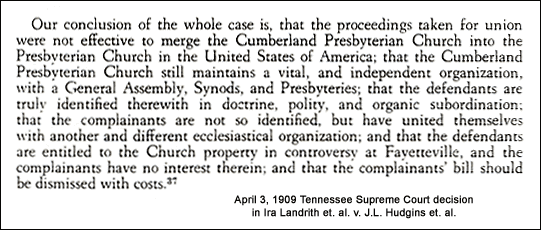
An April 3,
1909 Tennessee State Supreme Court decision reversed the
sentiments of earlier civil courts and effectively annulled
the union and returned church property to the anti-unionists.
Two days later, the Old Zion Church in White County
drafted a form letter, to also be used by the Old Union
Church, that demanded the church keys to be returned to the
anti-union Cumberland Presbyterians by Saturday, April 10,
1909. Presumably, on April 10, 1909 or
shortly thereafter, C.T. Haston and the Cumberland
Presbyterians of Union Church regained use and control of the
church building. The exile was ended...at least for this
segment of the old Union Church. The "unionists"
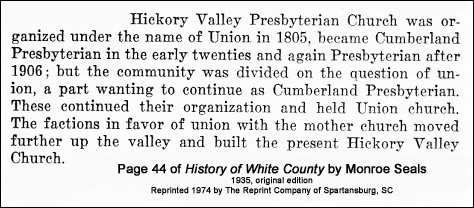
(pro-Presbyterian Church U.S.A. adherents) moved a mile north
up the road and built their own building and called themselves
the "Hickory Valley Presbyterian
Church." |
|
May 1909 -- Seventy-Ninth
General
Assembly of the
Cumberland Presbyterian Church |
May 1909 --
One Hundred-Twentieth-First
General Assembly of the
Presbyterian Church in the U.S.A. |
Union (White Co) was one of 26 churches on
the roll of the McMinnville Presbytery of the Tennessee Synod
of the Cumberland Presbyterian Church.
Several of the other churches probably had already chosen to
affiliate with the Presbyterian Church of the U.S.A., but were
kept on the Cumberland Presbyterian roll until it was
determined whether or not they could be reclaimed as
Cumberland Presbyterian churches.
(Only Information Given for this
Report)
|
Clerk |
Minister in Charge |
C.T. Haston,
Sparta, TN |
T.W*. Kittrell |
*On the roll of ministers for
the McMinnville Presbytery, the address of Rev. T.W. Kittrell
was Casville [Cassville], TN. Cassville is in southwest
White County, TN, not far from the Zion Church which Rev.
Kittrell also pastored.
Source: Minutes of the General Assembly of the
Cumberland Presbyterian Church, Seventy-Ninth Meeting,
May 20-26, 1909. |
Union was one of
the 23 churches on the roll of the McMinnville Presbytery of
Presbyterian Church of the U.S.A.
Richard H. Brown (of Sparta, TN) was the
stated supply pastor for Union, as well as Blue Springs,
Cherry Creek, Sparta, and Zion.
Union Statistics
|
Elders |
Deacons |
Added
by Exam. |
Added by Certificate |
| 4 |
1 |
8 |
5 |
|
Suspended
Roll |
Whole
Membership |
Adult
Baptisms |
Infant
Baptisms |
| 1 |
42 |
7 |
|
|
|
Home Missions |
Foreign Missions |
Education |
General Assembly |
| 7 |
3 |
2 |
2.00 |
|
|
Church Erection |
Sunday School |
| |
|
Source: Minutes of the General Assembly of the
Presbyterian Church in the United States of America, 121st
General Assembly (printed records dated August 1909) |
"Union Church Reorganized"
| June 13, 1909 -- A new Union
(CPC) church membership list was created by C.T. Haston
in the Union Church register under the heading, "Union
Church Reorganized." The
roll included 23 members, 10 of which carried the
"Haston" family name and were from the C.T. Haston
family. Some of the other 13 were from the C.T.
Haston family, although they had other surnames.
Does this June 13, 1909 church
reorganization indicate that the split loyalty (CPC &
PC-USA) factions had continued meeting up to this time
as one assembly, and that only now did they
separate? |
|
|
| |
|
| August 12,
1909 -- M.D. Haston and S.M.
Wallace
were elected to be elders and Walter Wallace was elected deacon of the
Union Cumberland Presbyterian Church.
All of them were installed in these offices.
Source:
Old Union
Church Minutes |
|
|
McMinnville Presbytery CPC
Session at the Short
Mountain Church
in DeKalb County |
McMinnville
Presbytery PC-USA
Session in Huntland, TN |
August 13-14, 1909 -- C.T.
Harton [Haston] represented the Union Church. The
"Haston" name was consistently typeset incorrectly throughout
these minutes* and the Union Church was said to be located in
Warren County, but it seems clear that this was C.T. Haston of the Union Church of White
County.
| *Fall 1909 through Spring 1911 sessions minutes were
printed in one combined booklet, thus the "Harton"
spelling continues through the minutes of five
subsequent sessions. |
C.T. Harton [Haston] was on the Committee on
Publication and the Committee to look after Churches that are yet in
the hands of the U.S.A. Church. The Committee of Publication
reported that "the Cumberland Banner...is as good if not the best
church paper in the world" and also recommended that "our people use
our Sunday-school literature, and our sessions endeavor to put the
Cumberland Banner in every Cumberland Presbyterian home."
According to the Committee on State of
Religion, "some of our congregations are not having regular
preaching, the elders in some places are trying to supply them
as best they can." The report went on to express "the
great need of lay preaching., as this is very much in demand."
A report by the Committee on Temperance stated that "we find
the sentiments of total abstinence from intoxicants is growing
among our people." A recommendation was made that
"ministers and elders, use their best efforts and influence to
stamp out the accursed drinks..."
Source:
August 13 (& 14), 1909 Minutes of McMinnville Presbytery of
the Cumberland Presbyterian Church. |
September 14-16, 1909 --
R.H. Brown was present at this presbytery session.
He was the stated supply minister for Sparta, Zion, Cherry
Creek, Blue Springs, and Union.
No ruling elder represented Union, Cherry
Creek, or Blue Springs.
|
Communicants |
Home
Missions |
Foreign
Missions |
| 42 |
8 |
8 |
|
| Education |
S.S. & Y.P.
Work |
Church
Erection |
| 5 |
1 |
1 |
|
Ministerial
Relief |
College
Board |
Church
& S.S. |
| 1 |
2 |
1 |
|
| Freedmen |
Temperance |
Total |
| 1 |
1 |
29 |
|
| Amt. per
Member |
Presbyterial Dues |
| .69 |
10.50 |
H.D. Brogden was listed as the Clerk of
Session for Union. His address was RFD 5, Sparta,
Tennessee.
Source: September 14-16, 1909 Minutes of the
Presbytery of McMinnville of the Presbyterian Church in the
United States of America. |
|